So, with all that considered, what's next? Is anything holy, or even safe from these species? What can we do to fight back against them? Well, luckily, there's guides for this sort of thing.
The USDA's National Invasive Species Information Center (NISIC) has a handy graph entitled the "Invasion curve," which we can use to help plan what to do. We only have a few trees-of-heaven here on Goucher's campus, so the curve recommends that the most efficient and least costly method of combating these species is the eradication of them from campus.
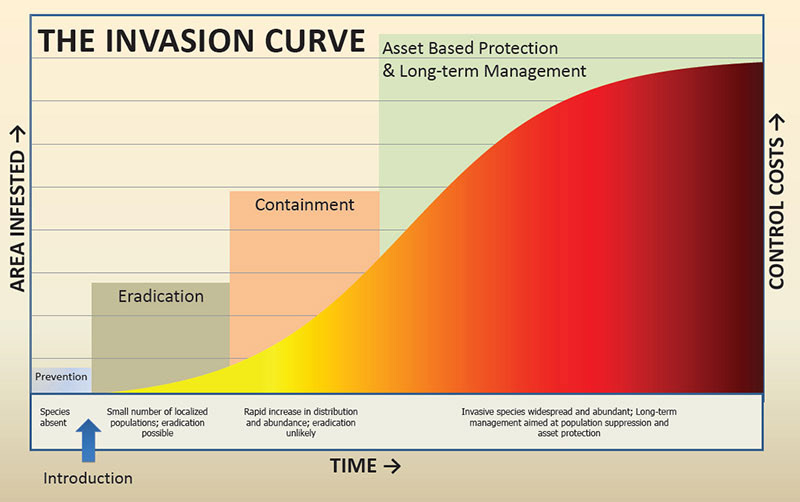
The invasion curve, courtesy of the United States Department of Agriculture's Forest Service. We're at the part which reads, "Small number of localized populations; eradication possible."
The Maryland Department of Agriculture has some recommendations for dealing with spotted lanternflies, too. The least environmentally impactful control methods are mechanical, including killing spotted lanternflies by hand, or by trapping them.
Another control method is insecticide, which has some important notes on. First and foremost, be very careful when using insecticides. Contact insecticides are not recommended for use, and systemic insecticides should only be used on the tree-of-heaven because, obviously, we don't want to kill a bunch of bugs that aren't invasive. Similarly, do not apply insecticide to lawns, as spotted lanternflies do not reside there.
To quote the MDA, "The only recommended cultural control for SLF is removing their primary host, the tree of heaven. This will not eliminate SLF, but it makes a property less attractive to them." Speaking of the tree-of-heaven, didn't we want to get rid of that anyways?
The solution to the problem of the presence of the pestering tree-of-heaven is quite simple, in theory: Just cut it down. First and foremost, though, we need to make sure we've properly identified trees-of-heaven on campus. Then, we need to chop them down safely, and after that, apply a systemic herbicide, best applied from July to the onset of fall color, when the tree is pulling stored energy down into its root system to survive the winter (UMD Extension).
Once that's all done, though, what should we do with all this space? I mean, sure, we could probably fit another Starbucks or something there, but how about this: Let's replace the invasive, harmful trees-of-heaven with one of America's greatest claims to arboriculture fame, the American chestnut.
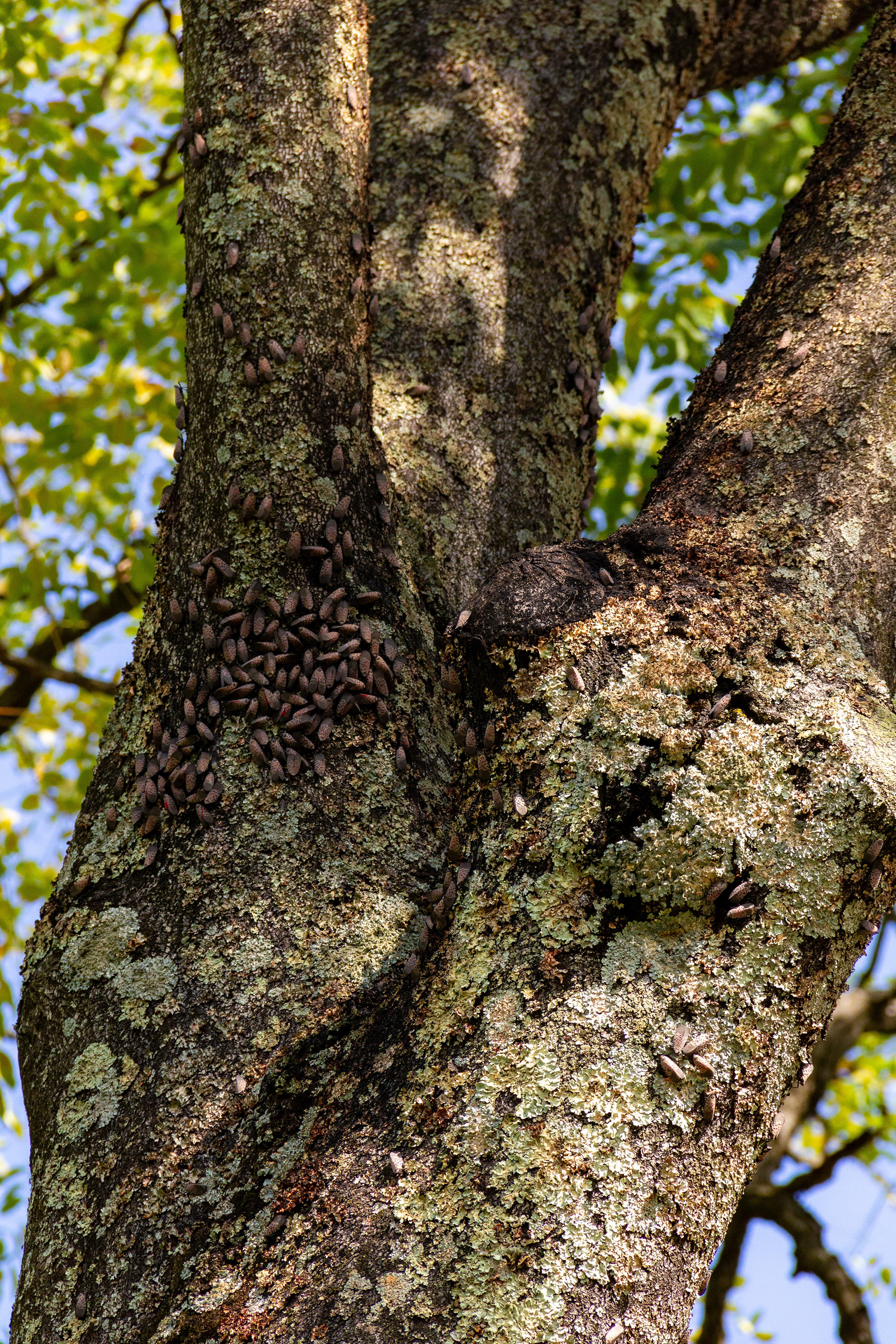
The Meyerhoff Arts Center's nearby tree-of-heaven is thoroughly infested with spotted lanternflies.
Why the American chestnut, you may ask? If you know an arborist, there's a non-zero chance that they've talked your ear off about it. The American chestnut was once a prevalent, important species here in the United States, but the introduction of chestnut blight from Japanese chestnut specimens decimated the population of the American chestnut. You may ask, since it's been so harmed by fungi and disease, wouldn't it just die when you plant it?
According to The American Chestnut Foundation (TACF), it's important to continue growing American chestnuts because it supports the mission to find, or create, a chestnut immune to that which killed its forefathers.
Transgenic chestnut trees, or chestnuts which contain slight amounts of other species' biological material, are currently going through federal deregulation, and another type of modified American chestnut, which have gone through a process called backcrossing, are available in small quantities. The TACF does still say that, to quote, "Growing wild-type American seedlings helps preserve genetic diversity for future breeding and diversification."
In addition to the environmental benefits of planting an American chestnut in place of campus' trees-of-heaven, it would be valuable for students and professors alike to share in learning the history of the American chestnut, providing prime opportunities to learn or teach about the importance of native species, how harmful it is to introduce diseases which species have no defense against, or any number of other natural phenomena related to the American chestnut.
So, how do we get all this done? We can't just act as guerilla arborists and ecologists, so there must be some recourse. In fact, depending on how you found out about this website, you might already know what I'm talking about.
Click the second button below to hear the good news about what we can do.
Click the second button below to hear the good news about what we can do.